
Residential HVAC Repair & Maintenance
Find the Cause.
Prevent the Next One.
When your air conditioner won’t cool or your furnace won’t heat, you need a technician who finds out why. Once your system is running, regular maintenance keeps it that way through 10 months of cooling and whatever the Gulf Coast winter brings.
Repair
Every Repair Starts With Why
Most service calls follow a predictable pattern: a technician finds the most visible symptom, replaces the most likely part, and leaves. When that doesn’t solve the problem, you get a second bill for a problem that was never actually solved.
We start with history
We ask when the problem started, what you’ve noticed, and whether anything changed recently. Intermittent problems in particular are frequently misdiagnosed by technicians who skip this step.
We document the system before we touch it
Frost patterns, oil streaks, and wear indicators often disappear the moment work begins.
We look past the symptom
A low refrigerant charge is almost never the root cause; it’s evidence of a leak. A tripped breaker is the system protecting itself, not the problem itself.
We verify the fix and leave a written record
We test the system under conditions as close to the original failure as possible, and every visit ends with a clear account of what we found, what we ruled out, and what we did.
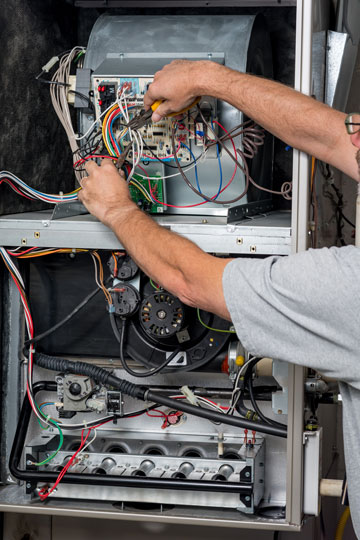
Repair First. Replace Only When It Makes Sense.
Our preference is to repair as quickly and cost-effectively as possible. When replacement makes more sense, we’ll explain why, so you can decide with the full picture.
What Usually Breaks
Repairs a Tune-Up Would Have Caught
Deferred maintenance doesn’t save money. It relocates it.
The August Emergency
A capacitor that fails on a 98-degree afternoon costs several times more to address as an emergency call than it would have as a routine replacement identified during a spring tune-up.
The Slow Drain
A condensate drain that hasn’t been cleared backs up, shuts the system down, or overflows into your ceiling or walls. In Houston’s humidity, this isn’t a hypothetical, it’s a common service call.
The Coil You Can’t See
An evaporator coil that hasn’t been cleaned in 3 years runs less efficiently every month, driving up your energy bill while quietly shortening the life of your compressor.
The Cold-Snap Furnace
Houston winters are mostly mild, which makes it easy to forget the furnace until a cold snap arrives. A furnace that rattles, pops, or bangs when it cycles is telling you something. Signs your heater needs attention →
Maintenance
Twice a Year. Spring Is the Critical One.
In Houston, twice-yearly maintenance is the appropriate standard. The spring visit matters most: a system that goes into summer unserviced carries every issue it accumulated over the previous year into its hardest months. The fall visit catches problems that developed over the summer and prepares your heater for anything from a hard freeze to a stretch of 70-degree days.
Spring cooling check
- Cleaning evaporator and condenser coils
- Checking and correcting refrigerant charge
- Inspecting and tightening electrical connections
- Testing capacitors and contactors
- Clearing and treating condensate drain lines
- Lubricating moving parts
- Measuring airflow
- Verifying system performance against manufacturer specifications
Fall heating check
- Inspecting the vent system and air intake grilles and clearing any blockages
- Checking the heat exchanger for damage or corrosion
- Examining and cleaning the blower
- Checking the blower motor and testing its amp draw
Finding a failing part before it fails gives you options: a planned repair on your schedule at a standard rate, rather than an emergency call at a premium.
Filter replacement frequency depends on your system, filtration level, occupancy, pets, and nearby construction. Your technician will advise on the right interval.
System Longevity
A Well-Maintained System Lasts. A Neglected One Doesn’t.
The national average lifespan for a residential air conditioning system is 15 to 20 years. Systems that receive consistent professional maintenance routinely reach and exceed that range; systems without it often fall short, and tend to fail at the worst possible times. Skipping professional maintenance can also void manufacturer warranty coverage.
Humidity Is a Maintenance Issue Too
Houston’s moisture levels affect more than comfort, they affect how hard your system works, how long it lasts, and what’s growing inside it. If humidity is a concern in your home, we address that as part of the same picture.

Fast, knowledgeable and honest! So thankful we found him! Had a new unit installed in less than 24 hours from him diagnosing it the night before! We have two kids and school was starting and he worked us in.
Cathy Anderson
Google Review
common questions
What to Expect From Repair and Maintenance
Should I repair my system or replace it?
It depends on what’s actually wrong. We diagnose first and recommend the cost-effective answer. Learn about new system installation.
Do you repair and maintain furnaces, heat pumps, and heaters too?
Yes. When a heater fails, we diagnose and repair it the same way we do an air conditioner: find the root cause first. We also recommend a heating check in early fall, before the first cold snap.
Can I finance a repair?
Yes. Financing through Wisetack is available for repairs and installations from $300 to $35,000. For more information, see our financing page.
What are your service hours?
Our standard service hours are Monday through Friday, 7 a.m. to 6 p.m., and Saturday, 7 a.m. to 3 p.m.
How often should I have my air conditioner serviced?
For most Houston homes, at least once a year, ideally in spring before the cooling season. Our climate puts HVAC systems under unusual stress: long cooling seasons, high humidity, and the moisture that encourages growth on coils and in drain pans. Because systems here run harder and longer than in milder climates, annual professional maintenance matters more, not less.
What is included in a maintenance visit?
A thorough visit covers far more than a quick look. We inspect and clean coils, check refrigerant charge and test for leaks, inspect electrical connections and components, check the condensate drain, measure airflow and temperatures, and document what we find. Following our diagnostic approach, we record system readings each visit so we can spot a developing problem before it becomes a breakdown.
Are maintenance plans actually worth it, or just a way to sell more?
A fair question, and one worth asking of any contractor. Honestly, the value depends on the system and the company. The real benefit of regular maintenance is catching small issues, a weakening capacitor, a coil starting to foul, before they become an expensive failure during a Houston summer. What you should never get is a visit that exists to find things to sell you. Our maintenance is diagnostic: we tell you what we find and what genuinely needs attention, and nothing more.
What happens if you find a problem during maintenance?
We show you what we found, explain why it matters, and give you an honest recommendation, including whether it genuinely needs attention now or can reasonably wait. Because we document system readings over time, we can often show you a measurement trending the wrong way rather than simply asserting something needs doing. The decision is always yours.
Will maintenance really lower my energy bills?
It helps, though no one should promise a specific number. A system with clean coils, correct refrigerant charge, and good airflow does not work as hard to cool your home, which shows up on your bill and extends the life of the equipment. In Houston, where systems run much of the year, the cumulative difference between a well-maintained and a neglected system is meaningful.
Can I do any of this maintenance myself?
Yes, and you should. Checking your filter monthly and replacing it when dirty, keeping the area around your outdoor unit clear of leaves and debris, and watching for changes in airflow or new sounds all genuinely help. What should be left to a licensed technician is anything involving refrigerant, electrical components, or opening up the equipment, both for safety and to protect your warranty.
More for Your Home
Repair & Maintenance →
Find the cause, make the repair, and keep your system running with spring and fall checkups.
Installation →
A new system sized to your home with a Manual J load calculation and backed by a 2-year labor warranty.
Mini-Splits →
Ductless heating and cooling for the rooms your central system can’t reach.
Air Quality →
Filtration, UV germicidal lights, and purification matched to what’s in your air.
Duct Systems →
Testing, diagnosis, and correction for ducts that lose conditioned air before it reaches your rooms.
Humidity →
Humidity control for a home that feels cold and clammy at the same time.