
Commercial HVAC Repair & Maintenance
Root-Cause Repair.
Planned Maintenance.
When a system fails, we diagnose the root cause before we replace anything. Then we maintain it to prevent the next failure. In Houston’s climate, a reactive approach to commercial heating and cooling is one of the most expensive ways to manage one of your largest capital assets.
Repair
Diagnostic Repair, Not Parts-Swapping
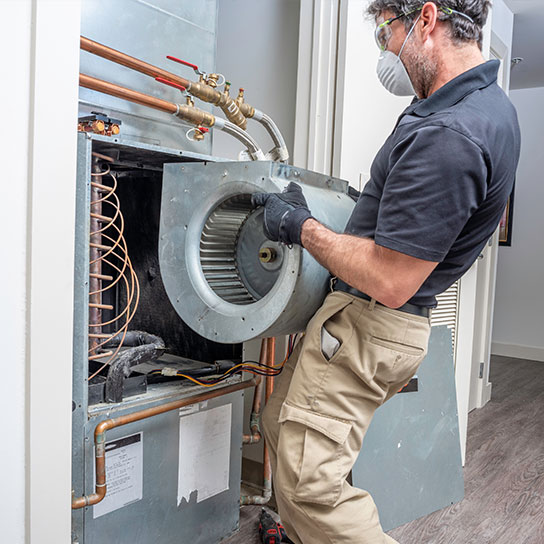
Most service calls follow a predictable pattern: a technician finds the most visible symptom, replaces the most likely part, and leaves. When that doesn’t solve the problem, you pay for a second visit and lose more time. Whether it’s a rooftop unit that won’t cool or a heating system that won’t keep up, we approach every repair the way an investigator approaches a case.
Before we touch anything, we gather history: prior service records, what your staff observed, and when the problem started. Intermittent problems in particular are frequently misdiagnosed by technicians who skip this step.
After any repair, we test the system under conditions as close to the original failure as possible and document what we found, what we ruled out, and what we completed. That record supports your maintenance planning and capital budgeting.
“Glad I called the right people. Took care of my problem right away. Very satisfied.”
Eagle Plumbing
Commercial Client
Maintenance
The Cost Doesn’t Disappear. It Accumulates.
Repairs fix what has already failed. Deferred maintenance costs more over time: it rarely shows up as a single line item, and the damage spreads across multiple budgets.
Energy
Dirty coils and clogged filters force equipment to work harder than it was designed to. The efficiency penalty shows up in your utility bill every month, compounding quietly until someone notices.
Equipment Life
Components running outside their design parameters wear out faster. The equipment you’re deferring maintenance on is shortening its own service life, and its replacement will arrive on the system’s schedule, not yours.
Liability
A system failure that results in uncomfortable or unusable space, or a mold or air quality event traceable to deferred maintenance, creates exposure that far exceeds the cost of the service visits that would have prevented it.
Our Process
More Complex Equipment. More Thorough Service.
A comprehensive commercial maintenance visit includes:
System check
- Inspection and cleaning of evaporator and condenser coils
- Refrigerant charge verification across all units
- Electrical inspection: connections, contactors, capacitors
- Belt and bearing inspection on air handling equipment
- Condensate system inspection and treatment
- Controls and thermostat calibration
- Airflow measurement and balancing
- Filter replacement on the appropriate schedule
Heating check
- Vent system and air intake inspection, with blockages cleared
- Heat exchanger inspection for damage or corrosion
- Blower inspection and cleaning
- Blower motor inspection and amp draw testing
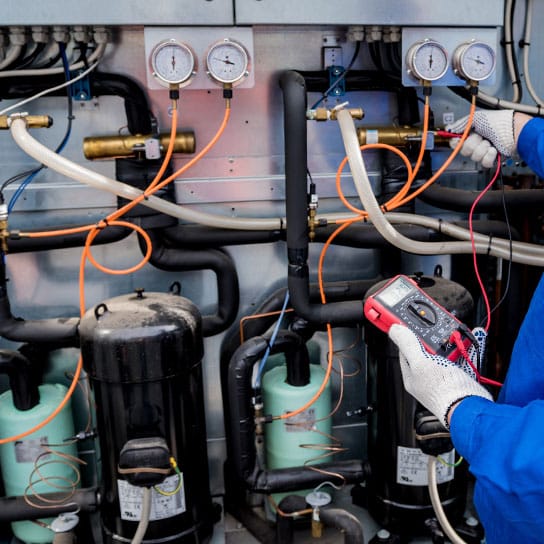
At every visit, we record temperatures, pressures, electrical draws, and airflow and compare them against prior visits. That record reveals trends a single snapshot never would, so you can address them on your terms.
How Often?
Quarterly at Minimum. More for High-Demand Environments.
Most commercial HVAC equipment in Houston warrants quarterly maintenance visits, with monthly filter inspections depending on occupancy density and building use.
High-demand buildings
Restaurants, medical facilities, and fitness centers typically require more frequent attention.
Rooftop units
Exposed to the elements year-round. Weatherproofing, economizer components, and drainage get inspected on every visit.
Off-hours scheduling
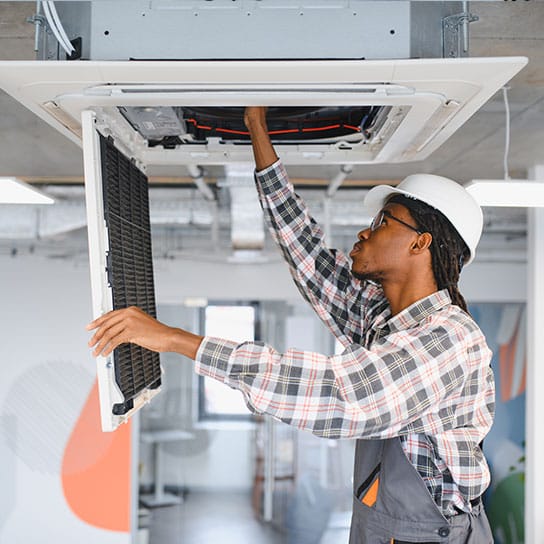
Servicing during low-occupancy periods minimizes disruption and lets technicians run systems through their full range.
The Difference
Familiarity With Your Building Is Worth Something.
The most effective commercial maintenance relationships are ongoing partnerships. A technician who visits your building regularly develops familiarity with your specific equipment, its history, and its quirks. That pays off in:
- Faster diagnosis when something goes wrong
- More accurate forecasting for capital planning
- System-specific insight a first-time technician can’t provide
Humidity Is a Building Performance Issue Too
In Houston, uncontrolled moisture in a commercial building creates problems that compound over time: mold, building material deterioration, occupant health exposure, and liability. It’s directly connected to how well your mechanical system is performing. If humidity is a concern in your building, we address that as part of the same assessment.

I’ve worked with Jim for three years now. I can always count on him to give prompt service and excellent customer service!
Pac Van
Commercial Client
common questions
What to Expect From Commercial Repair and Maintenance
Do you handle repairs as well as maintenance?
Yes. We install, service, and repair commercial heating and cooling systems of all types, from rooftop units to Bard wall-mount equipment in straight cooling, heat pump, and gas-electric configurations, across Texas, Louisiana, Oklahoma, and New Mexico. When we already maintain your equipment, the service history we’ve documented makes diagnosis faster.
How often should commercial HVAC equipment be serviced?
Most commercial HVAC equipment in Houston warrants quarterly maintenance at minimum, with more frequent filter inspections depending on how the building is used. High-demand environments such as restaurants, medical facilities, and fitness centers often need more attention. Rooftop units, the workhorse of most Houston commercial buildings, are exposed to the elements year-round and benefit from consistent inspection.
What does a commercial maintenance program include?
A comprehensive program covers inspection and cleaning of evaporator and condenser coils, refrigerant verification across units, electrical inspection, belt and bearing checks on air-handling equipment, condensate system inspection and treatment, controls and thermostat calibration, airflow measurement and balancing, and filter service on the right schedule. We also document system performance at every visit so you have a record, not just a service.
Why does documentation matter for commercial maintenance?
For a property manager or owner, the record is one of the most valuable things a maintenance program produces. We document temperatures, pressures, electrical draws, and airflow at each visit and compare them against prior visits. That longitudinal record reveals trends a single snapshot never would, a compressor slowly drawing more current, a coil gradually degrading, and it supports warranty claims, capital planning, and budgeting.
Can you schedule maintenance around our operating hours?
Yes. Our standard service hours are Monday through Friday, 7 a.m. to 6 p.m., and Saturday, 7 a.m. to 3 p.m. Scheduling preventive maintenance during off-hours or low-occupancy periods within that window minimizes disruption and lets technicians run systems through their full range without affecting comfort for occupants.
More for Your Business
Repair & Maintenance →
Root-cause repairs and quarterly maintenance with documented readings at every visit.
Installation & Design →
Systems designed around how your building is used and backed by a 2-year labor warranty.
Bard HVAC Units →
Self-contained, wall-mounted equipment for modular, industrial, and mission-critical applications.
Modular Buildings →
HVAC for job site trailers, modular classrooms, and permanent modular facilities.
Indoor Air Quality →
Filtration, purification, and ventilation with ERVs for occupied buildings.
Duct Systems →
Duct testing, diagnosis, correction, and design.